


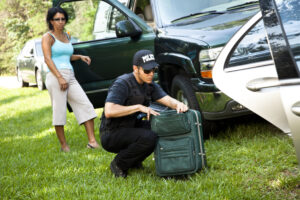
Drug possession charges often hinge on evidence obtained through police searches, making your Fourth Amendment rights crucial to your defense strategy. When law enforcement violates constitutional search and seizure protections, even possession of illegal substances may not result in conviction if evidence was illegally obtained. Understanding when searches are lawful and how to challenge improper police conduct can mean the difference between conviction and case dismissal.
Understanding Fourth Amendment Protections
The Fourth Amendment protects citizens from unreasonable searches and seizures by requiring police to have proper justification before searching your person, vehicle, or property.
Warrant requirements generally mandate judicial approval before searches, with specific exceptions allowing warrantless searches under limited circumstances.
Reasonable expectation of privacy determines when protections apply, extending to areas where you have legitimate privacy expectations like your home, vehicle, and personal belongings.
Probable cause standards require police to have reasonable belief that criminal activity occurred or evidence will be found before conducting searches.
Common Police Search Violations
Understanding frequent constitutional violations helps identify weaknesses in drug possession prosecutions:
Pretextual traffic stops occur when police use minor violations as excuses to investigate suspected drug activity without reasonable suspicion.
Coercive consent searches happen when officers pressure drivers or homeowners into agreeing to searches they can refuse, often through intimidation or false legal claims.
Improper vehicle searches exceed lawful search scope during traffic stops, such as searching closed containers without probable cause or searching vehicles after citation without additional justification.
Warrantless home searches violate protections when police enter residences without proper justification under recognized warrant exceptions.
When Police Can Search Without Warrants
Several exceptions allow lawful warrantless searches in specific circumstances, but these have strict limitations officers frequently exceed:
Search incident to arrest allows searching your person and immediate area for weapons and evidence during lawful arrest, but cannot extend to entire vehicles or distant areas.
Plain view doctrine permits seizing contraband visible during lawful presence, but doesn't authorize searches to look for hidden evidence.
Automobile exception allows warrantless vehicle searches when police have probable cause believing evidence is present, but requires specific justification beyond general suspicion.
Exigent circumstances permit emergency searches when evidence might be destroyed or public safety threatened, but cannot justify avoiding warrant requirements generally.
Challenging Illegal Search Evidence
When police violate Fourth Amendment rights, the exclusionary rule prohibits prosecutors from using illegally obtained evidence to prove drug possession charges.
Motion to suppress evidence challenges admissibility of drugs, paraphernalia, or other evidence obtained through constitutional violations, potentially eliminating the prosecution's entire case.
Fruit of the poisonous tree doctrine extends suppression to evidence discovered through illegal searches, including statements made after improper searches and additional evidence found through illegal results.
Standing requirements determine who can challenge search legality, generally requiring that your own constitutional rights were violated.
Defending Vehicle Search Claims
Vehicle searches represent the most common drug possession scenario, making automotive search law understanding crucial:
Traffic stop justification must be based on reasonable suspicion of violations or criminal activity, not profiling, hunches, or general drug enforcement.
Search scope limitations restrict officers to areas where evidence could reasonably be found, preventing fishing expeditions through entire vehicles.
Passenger rights protect vehicle passengers from searches unless officers have specific reasonable suspicion that passengers engage in criminal activity independent of the driver.
Consent withdrawal allows revoking search permission anytime, requiring officers to stop immediately unless they have independent justification.
Building Your Suppression Motion
Successfully challenging illegal searches requires detailed police conduct analysis and careful constitutional violation presentation:
Police report analysis identifies inconsistencies, omissions, and statements revealing violations officers may not have recognized or documented properly.
Witness testimony from passengers, bystanders, or residents can contradict police accounts and establish true search circumstances.
Video evidence from police cameras or security systems provides objective search documentation that may contradict officer testimony.
Consequences of Successful Suppression
When courts grant suppression motions, the impact on drug possession prosecutions can devastate the state's case:
Case dismissal often occurs when suppressed evidence was essential to proving possession and prosecutors lack alternative evidence.
Plea bargaining leverage increases significantly when key evidence faces suppression, forcing prosecutors to offer more favorable agreements.
Reduced charges may result when some evidence is suppressed but other evidence remains admissible.
Protecting Your Constitutional Rights
Drug possession charges based on illegal searches represent violations of fundamental constitutional protections requiring aggressive legal challenge. Police often exceed authority during drug investigations, hoping defendants won't understand rights or challenge improper conduct.
Law Office of Michael L. Fell thoroughly investigates every aspect of police conduct in drug possession cases, identifying constitutional violations that can result in evidence suppression and case dismissal. We understand complex constitutional law governing search and seizure and fight vigorously to protect clients' Fourth Amendment rights.
If you're facing drug possession charges in California, contact Law Office of Michael L. Fell at (949) 585-9055 immediately to discuss whether illegal search and seizure violations can invalidate evidence against you.