


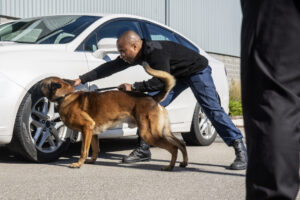
If you've found yourself unexpectedly pulled over by law enforcement, questions about the legality of the traffic stop might arise, especially in cases involving canine searches. Understanding your rights under the Fourth Amendment is vital. Through the lens of two distinct legal cases, let’s explore the boundaries of law when it comes to dog-sniff searches during traffic stops.
If you are facing legal charges after a canine search, contact Law Office of Michael L. Fell at (949) 585-9055 for a free legal consultation.
The Case of Ernesto Ayon
In the case concerning Ernesto Ayon, the contention was raised that officers extended his traffic stop unnecessarily, waiting for a drug-sniffing dog to inspect the scene. Ayon believed that this prolonged stop infringed on his Fourth Amendment protections from unreasonable searches. Subsequent to the court's initial refusal to dismiss the evidence, Ayon accepted guilt for several drug offenses.
The backdrop: Ayon was halted due to a minor traffic violation. Following a request to inspect his vehicle – which Ayon declined – officers detained him, alleging non-compliance. Nearly twenty minutes later, a drug dog revealed significant narcotics in his vehicle.
Yet, the Sixth District Court of Appeals later overruled this decision, establishing that the excessive delay orchestrated by officers, in anticipation of the canine inspection, was impermissible. Legally, traffic stops can only endure as long as it takes to address the primary purpose of the stop. Delays in the hope of finding unrelated evidence breach the Fourth Amendment, rendering such evidence inadmissible.
Delving into United States vs. Nault
Contrastingly, the verdict in the case of Nault showed a different facet of the law. Here, a prolonged hold in a parking space was deemed acceptable. When officers, having misidentified Nault, asked for his credentials, his evident inebriation caught their attention. A search unveiled illegal items, and a subsequent canine search discovered more contraband.
Nault's defense aimed to invalidate the evidence, arguing that officers should have released him upon realizing the identity mismatch. The court, however, upheld the officers' actions. In their perspective, asking for identification was still within their duties during a traffic stop. Nault’s apparent intoxication further justified the extended stop.
While Nault and Ayon yielded different outcomes, both decisions hinge on the precise context of the stop. In Ayon's scenario, there was no legitimate reason to prolong the stop. In contrast, Nault's evident inebriation provided grounds for extended investigation.
Canine Searches: Where Do You Stand?
The acceptability of a dog-sniff search during a traffic stop isn't black and white; it depends on each individual situation. If you find yourself entangled in such a circumstance, securing legal advice is essential. Reach out to Law Office of Michael L. Fell at (949) 585-9055 to determine if your Fourth Amendment rights were compromised.