


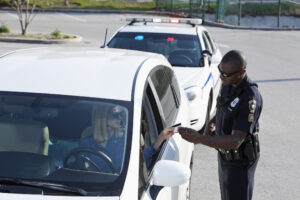
In California, you are not legally obligated to present your identification to law enforcement unless you are being lawfully detained or arrested. California does not enforce a “stop and identify” statute, unlike some states, that would make it a crime to refuse to provide identification.
However, if requested during a traffic stop, you are legally required to present your driver’s license to the police. Keep reading to learn more and contact Law Office of Michael L. Fell at (949) 585-9055 if you have been accused of or charged with a crime.
Responding to Police Requests for ID
Should a police officer request your ID while you are in a public or private location, maintain a courteous demeanor and inquire if you are free to depart. If the officer affirms that you may leave, you can depart without providing your ID. If the response is negative, then politely inquire about the reason for being stopped – however, refrain from volunteering additional information as it can potentially be used against you.
Hopefully, if the police realize there's no probable cause for an arrest, they would let you go. But if they do proceed with an arrest, remember to exercise your right to remain silent and to request your attorney's presence. Remember, any uttered words can be used against you.
Identification Requirements while Driving
During traffic stops, the law mandates you to present your driver’s license and proof of insurance upon the police officer's request.
Failure to present your driver’s license, or driving without carrying it, constitutes a violation of California Vehicle Code 12500. This traffic law is breached if you drive in the state and:
- Haven't renewed an expired driver’s license,
- Never obtained a driver’s license, or
- Became a California resident but did not acquire a California license within 10 days.
Penalties for Driving without a License
Driving without a license is classified as a 'wobblette' in California, and the prosecutor can decide to press charges as either a misdemeanor or a non-criminal infraction. Typically, the first offense is charged as an infraction with a penalty of up to $250. For repeat offenses, or if the prosecutor decides to file misdemeanor charges, penalties can include up to:
- 6 months in county jail, and/or
- $1,000 in fines.
Identification Responsibilities of Passengers
As a passenger in a vehicle that has been stopped by the police, you are under no legal obligation to provide identification. Driving violations fall under the responsibility of the driver. Unless the police have a valid reason to suspect you of a violation, they have no valid basis to request your ID.
Can I be Arrested for Not Providing Identification?
Non-drivers cannot be legally arrested in California solely for refusing to present identification to a police officer. However, some officers may still proceed with the arrest. Although a criminal defense attorney could help get your case dismissed quickly, the arrest could still have consequences. Therefore, providing identification to the police might be advisable.
For example, if you are on probation when arrested for failing to present your ID, it could initiate a probation violation hearing. If the hearing does not favor you, your probation might be revoked, and you could be sent to jail – even for an unlawful arrest. Furthermore, for non-citizens, an arrest, even an unlawful one, can initiate the immigration or deportation process.
Consequences of Providing False Identification to the Police
In California, it's considered a crime to either:
- Present a fake identification card to a police officer (Penal Code 148.9 PC), or
- Provide false information to a police officer (Vehicle Code 31 VC), like date of birth, address, or name. Both offenses are misdemeanors, attracting penalties up to:
- $1,000 in fines, and/or
- 6 months in county jail
If you have been charged with any crime, whether a driving related charge like a DUI or another crime entirely, contact Law Office of Michael L. Fell at (949) 585-9055 for a free legal consultation.